Sign the Petition: Say No to Racism in Puerto Rico!
Tuesday, March 24, 2015
Say No to Racism in Puerto Rico!
Sign the Petition: Say No to Racism in Puerto Rico!
Wednesday, October 8, 2014
Monday, May 5, 2014
Small Island Developing States Conference 2014 - SIDS
Not accredited? Apply by 12 May 2014
Accredited? Pre-register by 1 August 2014
The Third International Conference on Small Island Developing States will be held from 1 to 4 September 2014 in Apia, Samoa, to be preceded by activities related to the conference from 28 to 30 August 2014, also in Apia, Samoa
The participation of stakeholders from civil society and other non-state actors is organized according to the major groups structure articulated in Agenda 21. Representatives from major groups interested in participating as observers in the SIDS Conference and its preparatory process are required to be accredited to the United Nations and register accordingly.
Not accredited? Apply by 12 May 2014
Accredited? Pre-register by 1 August 2014
Visit http://www.sids2014.org
Wednesday, May 29, 2013
UCTP submission to UNPFII under Item 8: Future work of the Permanent Forum, including matters of the Economic and Social Council and emerging issues
Item 8: Future work of the Permanent Forum,
including matters of the Economic and Social Council and emerging issues
Wednesday, 29 May, 2013
Submission by the United Confederation of Taíno People (Caribbean Regional)
Presented by Roberto Mukaro Borrero
Takahi kena hahom. Greetings and thank you Mr. Chair:
The United Confederation of Taíno People is a regional initiative representing Indigenous Peoples of the Caribbean Islands. We have participated at every session of the UNPFII seeking to raise the visibility and promote a better understanding of the situations of Indigenous Peoples from this region, which is connected to Latin America in these proceedings.
Indeed, while the term Latin America and the Caribbean is promoted at various levels throughout the Permanent Forum sessions, as well as throughout the United Nations system, the full and effective participation of Indigenous Peoples of the Caribbean is unfortunately a rarity rather than the norm.
On the unusual occasion when Caribbean Indigenous Peoples, Indigenous islanders in particular, are highlighted within the system, there has been very little action on the part of U.N agencies or governments to engage in meaningful dialog or follow-up.
For example, the Programme of Action for the Second International Decade of the World’s Indigenous Peoples, under Item 6 Social and economic development, section b-85 states, and I quote:
“ It is recommended that representatives of Caribbean indigenous peoples should be included in region-specific consultations and conferences in Latin America and the Caribbean, and on steering committees for planning and implementing the programme of activities for the Second International Decade. Serious consideration should also be given to organizing a special regional consultative session focusing on the unique situation of Caribbean indigenous peoples, which would take place in the Caribbean, hosted by a Member State and a local indigenous community.”
Mr. Chair, to date there has been no such meeting and we are now nearing the close of the second Decade.
With this in mind, the United Confederation of Taíno People recommends that the Permanent Forum:
1.) Call on the Inter-Agency Support Group and Governments to support a regional consultative meeting on the situation of Caribbean Indigenous including Indigenous Peoples of non-self governing territories and unincorporated territories in the region, without discrimination.
2.) In cooperation with Indigenous Peoples, organize and hold an expert group meeting on the situation of Indigenous Peoples of non-self governing territories and unincorporated territories in 2014 and report on said meeting at its 13th session.
Hahom (thank you).
Tuesday, May 21, 2013
Annual United Nations Indigenous Peoples Forum begins
Saturday, March 9, 2013
Local Boriken Taíno Leader, Jose Xuerix Guaynia Camacho Passes into Koaibei
Xuerix Camacho was a renowned “Doo Wop” crooner for "The Sentimentals,"
a Boriken-based 1960's singing group, popular for their renditions of
romantic ballads and vocal harmonies. His artistic experience and
natural leadership abilities led him to advocate for indigenous justice
on the Island over the past 25 years. Xuerix participated in "El Grito de Kaguana", the 2005 community action that saw local Taíno leaders take over the Caguana Indigenous Ceremonial Center to highlight the desecration of sacred sites in Boriken.Wednesday, November 21, 2012
Fellowship – Rapporteurship on the Rights of Indigenous Peoples 2013
2) Modality: On-site
3) Deadline to present applications: December 15, 2012
4) Start and End Dates: February 1, to June 30, 2013
5) Length of the Fellowship: 5 months
6) Objective: To provide an opportunity for young lawyers from OAS Member States to understand and apply the mechanisms of protection of the inter-American system of human rights in the area of indigenous peoples’ rights. The Rapporteurship on the Rights of Indigenous Peoples of the IACHR was created in 1990 in order to strengthen, promote and systematize the IACHR’s actions in the area of indigenous peoples’ rights in the Americas.
7) Program: To assist with tasks of the Rapporteurship on the Rights of Indigenous Peoples of the Inter-American Commission, under the supervision of its human rights specialists during the period of the fellowship and, at the end of the fellowship, present to the Executive Secretariat of the IACHR a detailed report on activities carried out by the fellow.
8) Requirements:
- Be a citizen of an OAS Member State;
- Be member of an indigenous community of the Americas;
- Spanish language proficiency (knowledge of other official OAS languages is desirable);
- Have graduated in law from an officially recognized university (attach copy of the law degree and grades obtained);
- Have received law degree after January 1, 2005;
- Have a demonstrable professional interest in the legal field of human rights, specifically in the area of indigenous peoples’ rights; and;
- Present a paper of up to five pages, not edited by another person, on a human rights issue of interest to the candidate in the area of indigenous peoples’ rights.
- Letter of interest
- Completed Fellowship Application (LINK)
- Two letters of recommendation
- Curriculum vitae
- Copy of law degree and grades obtained
- Written paper of up to five pages
- The IACHR provides a monthly stipend of US$3,000.00 for the period covered by the fellowship, that is US$15,000.00 total for 5 months. With the stipend provided, the fellow is responsible for obtaining health insurance coverage of his/her choosing for the duration of the fellowship, and should provide proof of coverage to the Executive Secretariat of the IACHR.
- Round-trip economy class air transportation from the participant’s country of residence to Washington, D.C. Terminal and transfer expenses are not covered.
- The IACHR will award a certificate of participation in the Fellowship Program to the fellows who satisfactorily complete the entire period of the fellowship.
- Once an applicant has been selected, he/she should formally accept the fellowship in writing, confirming with the Inter-American Commission on Human Rights his/her availability to complete the fellowship during the specified time period. Once accepted, the IACHR will proceed with the necessary arrangements for purchase of round-trip economy air transportation between the candidate’s country of origin/residence and Washington, D.C.
- In the event a candidate accepts a fellowship but cannot complete it, for whatever reason, he/she must immediately inform the Inter-American Commission on Human Rights so that the course of action may be decided.
- It is the responsibility of each selected candidate to request and obtain the necessary visa to enter the United States, and/or transit visa (if applicable) in a timely manner. The IACHR will not incur in any expense related to the processing of immigration or visa documents. The IACHR will provide the candidate a document certifying his/her selection as an official fellow of the IACHR so that he/she may request the corresponding visa, which is the sole responsibility of the selected candidate. In addition, the OAS will send a diplomatic note to the Embassy or Consulate where the selected candidate will be requesting his/her visa, certifying the fellow’s selection.
- It is the responsibility of the selected candidate to arrive in a timely manner so that he/she will be present for the commencement of the fellowship on the date established by the IACHR.
- If the selected candidate declines the fellowship after the flight ticket has been purchased, or does not travel on the established dates or changes routes, the candidate shall reimburse the IACHR the cost of the flight ticket or any additional costs incurred. The latter includes any additional costs, if any, incurred by the IACHR, such as extra costs for accommodation during the candidate’s travel to and from Washington, D.C.
- If the candidate resigns, cancels or terminates the fellowship after the program has begun without providing sufficient reason and evidence to the IACHR for doing so, he/she will fully reimburse the IACHR for all costs incurred on his/her behalf.
The application and other required documents indicated in sections 8 and 9 must be submitted to the Executive Secretariat of the IACHR prior to the closing date of the application period, by email, fax or mail:
1889 F Street, N.W. Washington, D.C., 20006 U.S.A.
Thursday, February 16, 2012
Guyanese artist George Simon for Sabga award
(Trinidad Express) - Founder of the Adult Literacy Tutors Association (ALTA), Paula Lucie-Smith, has been named as one of three persons who will receive this year’s Anthony N Sabga Caribbean Awards for Excellence.
Michael Mansoor, chairman of the ANSA Caribbean Awards’ Eminent Persons Panel (EPP) selection committee, yesterday named Lucie-Smith, Prof Leonard O’Garro from St Vincent and George Simon from Guyana as this year’s laureates.
Each laureate will receive a cheque for TT$500,000, a medal and a citation at a ceremony expected to be held in early May, Mansoor said yesterday.
Mansoor made the announcements yesterday during a ceremony held at the Tatil Building, Maraval Road in Port of Spain.
Lucie-Smith’s organisation ALTA, which offers classes at 50 venues nationwide, has taken “significant steps” to tackle illiteracy in this country, Mansoor said.
O’Garro is a plant pathologist.
Archaeologist and fine artist George Simon (Lokono Arawak) “has recently made an archaeological discovery in Guyana that might cause history books about the pre-Columbian past of the Americas and world civilisation to be radically rewritten,” Mansoor said.
Source: Stabroek News
Saturday, February 11, 2012
UNPFII Eleventh Session // Undécima Sesión
El pre-registro para asistir a la sesión 11 del Foro Permanente, está ABIERTO, visite el sitio web en http://social.un.org/index/indigenouses/Portada/SesionesUNPFII/UndecimaSesion.aspx
Friday, November 18, 2011
“End the Secrecy!” – SATIIM Demands Explanation for US Oil Company’s Return to National Protected Land
*Defies historic Supreme Court ruling based on country’s constitution and the United Nations Declaration on the Rights of Indigenous Peoples.
The Sarstoon Temash Institute for Indigenous Management (SATIIM) calls all those who care about Belize’s biocultural diversity demand that the government explain what an oil company is doing on protected land.
On October 25 SATIIM learned that the American oil company, US Capital Energy had suddenly re-appeared on protected and Maya land -- without prior notice or consent of the communities.
According to reports, the oil company has been operating for over a week inside the Sarstoon Temash National Park (STNP) in Southern Belize. While the park is officially co-managed with the surrounding Q’eqchi Mayan and Garifuna villages, the government never informed SATIIM that a permit had been issued. The company is wasting no time -- a truck equipped for seismic drilling has already arrived along with a drill-ready tractor. Trees were cut for two seismic lines in Sunday Wood village, with rumors of plans to cut more in the village of Crique Sarco.
This is merely the latest ‘surprise’ in a shameful history of secrecy that began one morning in 1997. Five Indigenous communities in Southern Belize woke up to learn that the government had declared their ancestral land a national park in 1994. Ever since, these communities have struggled to defend their land at every turn.
Notably, in 2006 they won a temporary injunction against seismic testing in this protected area, where an entirely new ecosystem was recently discovered. Another ruling from the Supreme Court confirmed Maya rights to land and resources and Belize’s obligation to conform to international standards of informed consent established when it signed the UN Declaration on the Rights of Indigenous Peoples (UNDRIP) in 2007.
Nonetheless, the government has kept all dealings with US Capital Energy secret. SATIIM asked for information in several letters to the Prime Minister, Deputy Prime Minister and Chief Forest Officer. The government has ignored each one.
When SATIIM met with Indigenous leaders Monday 7 November, all villagers expressed outrage and growing concerns that the government and the company did not inform them about the seismic activities. SATIIM demands that the government respect: 1) the rule of law; 2) environmental justice; 3) economic equality; and 4) its obligations under UNDRIP and legal rulings by Belize’s highest courts.
Most of all, SATIIM demands the government end the secrecy around US Capital Energy’s new operations in Southern Belize. SATIIM and the Indigenous communities have agreed to use any means necessary to bring the government and company in compliance with national and international law.
Source: SATIIM PRESS RELEASE
Wednesday, August 17, 2011
Indigenous clans call for recognition of their rights
See the full story at UCTP Taino News:
http://www.uctp.org/index.php?option=com_content&task=view&id=704&Itemid=2
Wednesday, January 5, 2011
Gov’t proposes US$12M Amerindian land titling, demarcation project
Over four years—from 2011 to 2014—it envisions US$12M being spent on the process and a budget of US$3.6M has already been outlined for 2011. A description of the project says that underlying the development of the Low Carbon Development Strategy (LCDS) is the protection of Indigenous land rights and the opening of windows of opportunities for the Amerindians, especially those that depend on forest resources as a means of livelihood. It is expected that demarcation and titling of communities will strengthen land tenure security and expansion of the asset base of Amerindian villages and allow for long term planning for their future development. “The objective of this project is to facilitate the fast-tracking of the Land Titling and Demarcation process to allow the villages to understand the boundaries of the lands they own and how much land they can exert control over; thereby enhancing and securing the position of villages to ‘opt-in’ to the REDD+ and the LCDS and allow them to better manage and develop their lands in a sustainable manner,” the document states.
According to the document, Amerindian land rights have always been a priority for the government and to date; Amerindians collectively own 13.9% of Guyana’s land mass. It says that the titling and demarcation of Amerindian lands will positively impact on Guyana’s achievement of Millennium Development Goal 1 – Eradicate Extreme Poverty and Hunger, since the Amerindians are the poorest group of persons in Guyana. According to the Household Budget Survey (2007), 77% of Amerindians were classified as poor. It is expected that poverty would be reduced to 28% though stimulation of growth and job creation.
The document states that the land titling and demarcation process will be guided principally by the Amerindian Act, and other Acts related to land titling and on the principle of first come first serve basis. Additionally a mechanism will be developed to address ongoing disputes with the land titling and demarcation and any new disputes which may arise and a communication strategy to allow for sharing of information. Opportunities for improvements to ensure that the issuance of land titles and the demarcation process are done in a timely and efficient way will be explored and where possible supported.
Overseeing the project will be a Project Board, which is the group responsible for making by consensus, management decisions for a project when guidance is required by the Project Manager, including recommendations for UNDP/Implementing Partner approval of project plans and revisions.
“In order to ensure UNDP’s ultimate accountability, Project Board decisions should be made in accordance to standards that shall ensure management for development results, best value money, fairness, integrity, transparency and effective international competition. In case a consensus cannot be reached within the Board, final decision shall rest with the UNDP Programme Manager,” it says.
The board contains three roles: an Executive, who is an individual representing the project ownership to chair the group; Senior Supplier: individual or group representing the interests of the parties concerned which provide funding and/or technical expertise to the project. The Senior Supplier’s primary function within the Project Board is to provide guidance regarding the technical feasibility of the project; and Senior Beneficiary: individual or group of individuals representing the interests of those who will ultimately benefit from the project.
Under the Board is the project manager, who has the authority to run the project on a day-to-day basis on behalf of the project board within the constraints laid down by the Board. The Implementing partner appoints the Project Manager, who should be different from the Implementing Partner’s representative in the Project Board.
The UNDP will provide financial resources entrusted from the GRIF to the implementing partner – the Ministry of Amerindian Affairs. It will also provide Oversight and Quality Assurance, to ensure that UNDP’s fiduciary, social and environmental standards are adhered to and to develop a Capacity Development plan.
The Ministry will partner with the Guyana Lands and Surveys Commission to demarcate and titled lands. The project will be audited and monitored and annual reports submitted.
Guyana has signed an agreement with Norway whereby the Scandinavian country pays US$250M over five years for this country to protect its forest. The first tranche of US$30M has already been paid into the GRIF.
Source: Stabroek News
Tuesday, November 30, 2010
Sub-regional Meeting of Indigenous Peoples from North America and the Caribbean: Follow-up to the III Indigenous Leaders Summit of the Americas (ILSA)
Dear Indigenous Peoples' Representatives,
Greetings from the Summits of the Americas Secretariat (SAS) of the Organization of American States (OAS). This Secretariat is pleased to announce, in collaboration with the Assembly of First Nations (AFN), the Native Women's Association of Canada (NWAC) and the Inuit Circumpolar Council [ Canada ] (ICC), a Sub-regional Meeting with Indigenous Peoples' representatives from the English-speaking countries of the Americas to be held in Ottawa ,Canada, on Monday, December 13, 2010.
The main purpose of the Sub-Regional Meeting of Indigenous representatives from Canada, the United States and the Caribbean region is to provide an opportunity to follow-up on the implementation of the April 2009 Declaration and Plan of Action of the III Indigenous LeadersSummit of the Americas (III ILSA) "Implementing the Rights of Indigenous Peoples of the Americas for Present and Future Generations" and the participation of Indigenous Peoples in the Inter-American System. It will also provide an opportunity to begin preparations for the IV ILSA in the context of the initial planning stages of the Sixth Summit of the Americas .
The Seminar will be open to the participation of anyone from the general public interested in this theme. If you would like to participate, please fill out the Registration Form and email it toamontilla@oas.org, with a copy to celestemckay@me.com, before December 8th, 2010. Please note that each participant must cover his/her own expenses.
For those who cannot attend the event, the Summit Secretariat is pleased to announce that theSummits Virtual Community (SVC) will be available for all those individuals interested in contributing to discussions. This Community offers its visitors the opportunity to register and participate in forums and discussion groups, as well as obtain materials, such as documents, videos, links, etc. In the SVC, the visitor can also share comments and opinions with other people who are interested in common themes. To participate in the Indigenous Peoples Group, please click here or visit: http://svc.summit-
Updated versions of the agenda and other relevant documents will be disseminated shortly. More information about this meeting will also be published in the Summits of the Americas Information Network at: www.summit-
For more information, please contact Andrea Montilla (AMontilla@oas.org or at 202.458.3347) or Celeste McKay (celestemckay@me.com or at 613.858.7070).
Kind regards,
Summits of the Americas Secretariat of the Assembly of First Nations (AFN)
Organization of American States (OAS)
Native Women's Association of Canada (NWAC) Inuit Circumpolar Council (ICC)
This sub-regional event is made possible in part through the generous support of the Spanish Agency for International Development Cooperation
Saturday, April 17, 2010
Amerindian communities likely to get up to $7M extra for development
According to the Government Information Agency (GINA), the president said the sums ranging from $5 million to $7 million will be used to promote food security and profit-making ventures.
He said with funds expected from the implementation of the Low Carbon Development Strategy (LCDS), he had decided to set aside about US$5M (equivalent to G$1B) in addition for Amerindian communities’ development.
As regard food security, Jagdeo stressed the importance of better drainage and irrigation systems, which he said will boost agriculture productivity and diversify the range of products grown. Guyana is expected to be able to expand access to services and provide new economic opportunities for Amerindian communities within the framework of the LCDS.
“The draft LCDS document states that transforming Guyana’s economy will require among other things, striking a balance between using forest payments to enhance the opportunities for those who live in the forest and recognising the rights of other Guyanese citizens, including the urban poor,” GINA said.
In June 2009 the Ministry of Amerindian Affairs partnered with Voluntary Services Overseas (VSO) to launch the National Secure Livelihood Programme (NSLP) which sought to address the challenges hampering economic development in the Amerindian villages and hinterland communities through the creation of employment opportunities, sustaining food security, income generation, wealth creation, economic diversification and secure livelihoods. Six VSO Specialists were employed to spur economic development in Region One, focusing on agriculture, aquaculture, pest management, food technology, business, development, marketing and finance and organisational development.
According to GINA, the Presidential Grant was established in 2007 with $150M allocated for meeting the social and economic needs of 140 communities. The Grant was also offered in 2008 but last year 20 additional communities became eligible for grants and as a result $160M was allocated.
Source: Stabroek News
Tuesday, March 9, 2010
Bolivia's President Evo Morales, left, accompanied by Bolivia's Justice Minister Nilda Copa, talks during a press conference after the closing ceremony of the Rio Group summit, on the outskirts of Playa del Carmen, 68 kms, some 42 miles, south of Cancun, Mexico, Tuesday, Feb. 23, 2010. Leaders of 32 nations have agreed to create a new regional bloc including every country in the Americas except Canada and the U.S. (AP Photo/ Israel Leal)See full story at UCTP Taino News
Tuesday, October 20, 2009
Moraikobai looks to large-scale agriculture, call for govt assistance
As part of the celebration of Agriculture Month, Minister of Agriculture, Robert Persaud visited the area on Saturday to “address” some of the concerns of residents and assured them that they would get the required support. At the end of his address he presented a quantity of fruit and vegetable seeds, chemicals to deal with acoushi ants along with two breeding pigs to Toshao Dereck John. The items would be used to benefit the community.
The residents had gathered for training sessions including farming techniques, controlling pests and proper care of animals, conducted by technical staff of the Agriculture Ministry and the Guyana Forestry Commission.
John expressed gratitude for the items they received. He told this newspaper that residents were also grateful for the knowledge they were gaining from the training sessions. “Technical personnel are not here so these people come in to teach us and demonstrate to us and it is a big boost to the community,” he said.
The minister told the residents that while the community relied on logging he was happy that residents have been exposed to the discussion on the LCDS and what is happening in terms of climate change and that they would be part of the strategy.
He also pointed out that the LCDS is not intended to impinge or interfere with their livelihood but that government would ensure that the community has a stable and sufficient supply of food and that there are no disruptions in terms of forestry activities.
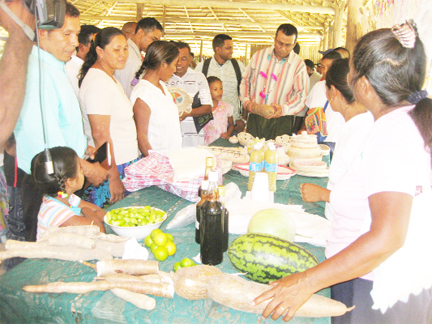
A mini exhibition, showcasing ground provision and as well as craft items made by the women, was also held. The women raised the issue of their crafts not being sold despite efforts to display them at various exhibitions.
Persaud then advised them to be a part of AGRIFEST at the National Stadium on October 31 as a way of securing markets.
Meanwhile he took the opportunity to ask Jamaica’s Minister of Commerce Michael Stern who was in Guyana on a business trip and joined the team on the visit to take note of the women’s concerns about markets.
Stern, who promised to assist in that regard, advised the people “to try and do as much as you can to create wealth in your community. Through that wealth creation you would become more sustainable and your children would have a better life…”
He said too that if they take advantage of all the assistance that they were getting they would have a successful community. He even promised to return one day to enjoy some of what they produce. The community had received computers for a state-of-the-art computer laboratory which is currently being housed at the primary school until a building which is currently being constructed for lab is completed. The building, according to the Toshao, would also be used for farmers’ training.
Persaud mentioned that on a previous visit residents had complained that the computers could not be used because the area only gets electricity at nights and that a generator has since been provided.
The residents said the community is having problems accessing potable water and Regional Chairman Harrinarine Baldeo informed residents that Minister of Housing and Water Irfaan Ali would be visiting this week.
Permanent Secretary of the Ministry of Amerindian Affairs Nigel Dharamlall who was also part of the team told the Amerindians that the ministry intends to continue serve them and that the budget proposed for next year is bigger.
Dharamlall said too that all Amerindian villages are considered vulnerable and that the ministry has recently launched a Database Management Information System to capture all the problems affecting them as well as the proposed solutions.
Friday, August 7, 2009
Kalinago Carib Elect New Chief in Dominica
Waitukubuli/Dominica (UCTP Taino News) - Elections were held in July in the Carib territory of Dominica, West Indies to choose a Chief for a new 5-year term of office. Former Chief Garnet Joseph won the election over incumbent Charles Williams.
Joseph said his work focus will include health, education and respect for council members in the Territory. The new chief has also pledged to bring more development to the 3,800-acre (1,538-hectare) territory, where Caribs live in greater poverty than the rest of the country. Dominica is home to about 3,000 Caribs, or ethnic Kalinagos.
Sunday, August 2, 2009
Hugo Chavez in Dominica to unveil $35M facility
Chavez said the complex that Venezuela helped build will store 35,000 barrels of diesel, jet fuel and cooking gas.
The Petrocaribe program, which Dominica participates in, was created in 2005 to supply fuel to allies under preferential terms.
"Dominica will no longer have to concern itself about the supply of gasoline and oil,'' he told a cheering crowd. "All the oil Dominica will need for the next 200 years will be right there in Venezuela.''
People wearing red T-shirts in support of Chavez lined the streets for about two miles (three kilometers) as he made his way from the airport to the facility.
Prime Minister Roosevelt Skerrit promised to supply free cooking gas to poor people, but he did not provide details.
The storage complex is located near the capital of Roseau and is named ''Waitukubuli,'' the Carib Indian name for Dominica.
Chavez said he also will help fund a coffee-processing plant in the tiny Caribbean island and set up a local branch of a leftist Latin American trade group.
Source: Associated Press
Tuesday, June 16, 2009
PR Representative Vassallo urges respect for Taino

Photo: In Ponce, UCTP Boriken Liaison Roger Guayakan Hernandez looks on as the Hon. Victor L. Vassallo Anadón signs the official proclamation urging respect for Taino People in Puerto Rico.
UCTPTN 06.16.2008
Sunday, April 26, 2009
Global Indigenous Climate Summit Concludes in Alaska
Miguel d'Escoto Brockmann, and Hariette Vreedzaam - Joeroeja (Galibi - Suriname)
express their solidarity at the Global Indigenous Peoples' Summit on Climate Change in Anchorage, Alaska.
See full story at UCTP Taino News