Tuesday, June 9, 2009

Massacre in the Peruvian Amazon

The Peruvian military attacked unarmed Indigenous protesters in Bagua Chica, in the northern Amazon region. The attack which included snipers and helicopters started early last Friday until late Saturday. (Photo: © Enlace Nacional & Catapa)


Peru (UCTP Taino News) - Effectively shutting down parts of the Amazon and the Andes for over 50 days, local Peruvian communities have been engaging in massive strikes organized to protest government proposed development in the region. On Friday, June 5 the peaceful protests were met with a violent military response by the Peruvian government leaving civilians and police dead with hundreds more injured.

As a result of an almost total media blackout, unconfirmed casualty reports from the area have ranged from 38 civilians and 10 police to 100 civilians and 22 police dead.


On April 9, an "indefinite strike" began throughout the Amazon region to protest the Peruvian Congress' failure to review six government decrees that are identified by local leaders as endangering the rights of Indigenous Peoples. These decrees were issued by Peruvian President Alan García Pérez and relate to the implementation of Free Trade Agreements signed with the United States and Canada. Opposed by Indigenous Peoples, the legislation paves the way for oil, mineral, and agricultural exploitation in the ecologically sensitive region.

Following an international Indigenous Peoples summit held in Puno, Peru last week, the Coordinating Body of Andean Indigenous Organizations (CAOI) issued a call for an “international denunciation” of President García Pérez and his administration for the “bloody repression of Indigenous Peoples in the Peruvian Amazon”. The CAOI has called upon indigenous organizations, social movements and human rights organizations around the world to take concrete action by sending letters to the Peruvian government, the United Nations Special Rapporteur for Indigenous Peoples and other relevant parties to demand an end to the violence and respect for indigenous rights.

A coalition of indigenous, human rights and environmental organizations are urging the Garcia Government to step down and cease violent confrontations by the military.


AIDESEP, the national indigenous organization of Peru has called for a nationwide general strike starting June 11th. Emergency solidarity demonstrations are being scheduled at Peruvian Embassies around the world to coincide with the national actions. For additional information visit the Amazon Watch and AIDESEP websites.

UCTPTN 06.09.2009

Thursday, June 4, 2009

New law Threatens Ancient Indigenous Patrimony in Puerto Rico

San Juan, Boriken (UCTP Taino News) - The Puerto Rican Senate and House of Representatives are deliberating on the approval of revised Permit Law Projects that opponents state would endanger the Caribbean island’s environmental and archeological patrimony. Local archeologists, environmentalists, and indigenous Taino groups are calling on the government to abandon this process involving Permit Law Projects No. 880 in the Senate and No. 1649 in the House of Representatives.

The Permit Law Projects are being touted as much needed initiatives that would to re-structure and expedite construction permits on the island. As noted by several public statements made by those opposed to the projects, the proposed legislation would nullify current legal protections for environmental and archaeological resources while favoring development with little oversight.

“This proposed policy would also regulate ‘public’ participation in these processes to an informal position” stated Naniki Reyes Ocasio, a local Taino community leader.

Reyes Ocasio continued stating “This permit law proposal is a violation of the United Nations Declaration on the Rights of Indigenous Peoples, an international human rights law standard that calls for prior and informed consent.”

A demonstration calling on the government to abandon the current Permit Law Projects will be held tomorrow, Friday June 5 in San Juan, Puerto Rico. The event will begin at 11am at “Puente Dos Hermanos” in the Condado area where Ashford Avenue ends and leads into Old San Juan. For more information on the demonstration contact “Coalición Todo Puerto Rico Por Puerto Rico” at 787-274-8087, 787-502-0194 or bsantiago@alianzaseiu.org.

UCTPTN 06.04.2009

Wednesday, May 27, 2009

Solar power pilot for some Mabaruma communities

GUYANA - Some areas in the Mabaruma Sub-Region in Region One (Barima/Waini) will be part of a pilot programme that will see the provision of solar electricity.

According to a release from the Government Information Agency (GINA), Minister of Amerindian Affairs Pauline Sukhai, PPP General Secretary Donald Ramotar and Permanent Secretary in the Ministry of Health Hydar Ally, visited more than 15 communities, including Barima, Aruka, Wauna/Tobago, Almond Beach and Hobodia during the outreach between the period May 15 through 19.

While addressing social issues during the visit Sukhai told residents of Yarakita they were part of a pilot programme, the Unserved Areas Electricity Programme( UAEP), an Inter–American Development Bank funded programme, which will provide solar power to outlying areas. If the programme is successful it will be expanded in the future. There is however, no guarantee as to whether it will be extended to all the villages since the government will have to provide funding to move the programme forward, the release noted.

Sukhai said the Government of Guyana is expected to acquire 1,000 solar units which would be used to provide minimum electricity to some villages. While the units do not have the capacity to provide power to appliances they will be able to provide light for approximately four hours to each community, to the benefit to children during study periods.

Yarakita was the recipient of a new primary school and according to Ramotar, the administration has trained a lot of teachers who are occupying leading positions in various schools. He gave assurances that the issue of absenteeism by teachers will be raised with the Ministry of Education after receiving complaints from residents in that community.

Some $710M was allocated to the national school feeding programme to benefit students in different administrative regions, including Regions One and the programme has brought about a marked difference in attendance rate as more children attend school, especially in Hinterland areas, GINA stated.

As regards the lack of birth certificates, Sukhai said that 400 original copies of the document had been sent into the area and were being checked and collated after which they will be forwarded to the Toshaos for distribution.

She explained that the Amerindian Affairs Ministry is actively pursuing the issue after explaining to residents that the ministry depends on the General Registrar’s Office for assistance.

The team provided an update to residents on the Secure Livelihood Programme which is slated for Region One. Sukhai said the Amerindian Affairs Ministry, the Ministry of Agriculture and the Voluntary Services Overseas (VSOs) of Guyana are coordinating with a number of specialists who will be placed in that region to provide assistance whereby 15 communities in the area will benefit from specialist and expert skills, the release said.

Specialists in enterprise development, finance and marketing as well a food technologist will be available to residents, Sukhai said. They will enable residents to better market their products in a manner in which they will be adequately compensated.

Meanwhile, Ally, who visited the Mabaruma Hospital and the nurse’s hostel which is under construction, told residents that strides have been made in the health sector as he related that maternity deaths have reduced to a level that is even better than other parts of the Eastern Caribbean.

GINA stated that the malaria eradication programme has been successful and these and other aspects of development have been made possible through the efforts of the government.

Source: Stabroek News

Thursday, May 14, 2009

Kabakaburi gets $1M presidential grant

GUYANA - A $1M Presidential Grant was recently awarded to Kabakaburi to acquire a high-powered outboard engine to boost transportation services in the village.

According to a Government Information Agency (GINA) press release the Pomeroon River, Region Two community is the latest Amerindian village to benefit from a Presidential Grant.

Lorna Williams who has been re-elected Toshao of Kabakaburi, received the Grant from Amerindian Affairs Minister Pauline Sukhai. This is the third Grant that the village has received and it will be used to purchase a more powerful outboard engine for the passenger boat which it owns and operates. The new engine will reduce the amount of travelling time from Kabakaburi to Charity where persons conduct business and students attend school.

According to Williams the boat leaves the village very early which means that students have to be ready to board at an early hour to attend the Anna Regina Secondary School. She said too the passenger service is also an economic venture which benefits the entire community as it provides a cheaper service than the other private passenger boats.

Williams said she was grateful for the grant and that it will be used to aid development in the village. She said since she was elected there has been significant development in the village as both the council and the villagers work together to develop the community.

GINA said the village received its first Presidential Grant in 2007 which was used to build the boat that now serves the community. This council also constructed two community stellings for passengers’ convenience. A guest house and a village shop were also built with funding from the previous presidential grants.

Williams said plans are also in train to build a kitchenette at Aripiaco to replace the old one. Meals for the school feeding programme are often prepared at the kitchenette. The village is seeking another grant from the ministry for this project. The community also received a solar panel for the first time to power the health centre.

Source: Stabroek News

Friday, May 8, 2009

Three Amerindian villages receive Presidential Grant

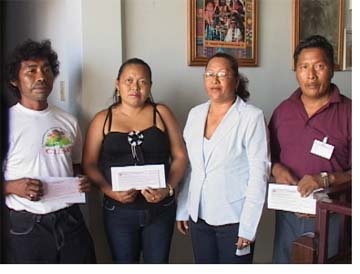
Minister of Amerindian Affairs Pauline Sukhai (second from right) with Toshaos (from left) Felix Williams, Julie Johnson and Ekufa Mewsha (GINA photo)

Minister of Amerindian Affairs Pauline Sukhai (second from right) with
Toshaos (from left) Felix Williams, Julie Johnson and Ekufa Mewsha (GINA photo)

GUYANA - The Micobie, Parabaru and Karisparu Amerindian communities recently obtained Presidential Grants totalling $2.1M for enhancement works.

A Government Information Agency (GINA) press release said Minister of Amerindian Affairs Pauline Sukhai presented the grants to the communities on Wednesday. “The programme provides communities with the financial resources necessary to fund projects that aim to provide the required services within their communities and help to make them more economically viable.”

Newly elected Toshao Julie Johnson of Micobie, Region Eight received a $1.2M grant which she said will be used to construct a ‘rest house’ in the area.

The building will provide accommodation for visitors; a paid service that will generate income for the community. Johnson said currently visitors do not enjoy adequate accommodation.

Karisparu Toshao Felix Williams received $886,000 to expand the village shop in his Region Eight community. This will preclude residents’ need to travel to other villages or communities to purchase supplies. The current community was funded by sums from a Presidential Grant and according to Williams residents had expressed the need to expand it.

Ekufa Mewsha, Toshao of Parabaru Village received the final portion of the grant. According to Mewsha this is the third Grant the Region Nine village has benefited from and it will be used to complete a village office that is now being built. Village council meetings will be held in the office which will replace the benabs previously used.

According to GINA the minister presented the grants to the toshaos and congratulated Mewsha on being re-elected. Sukhai said she hopes the grants would be used responsibly and that the projects will be sustainable and benefit the entire community.

The minister said the Presidential Grant programme is used to fund community projects. These include productive and economic projects ranging from the expansion of village farms, eco lodges, building dams, clearing trails, providing kitchen facilities for school feeding programmes and cattle rearing. Sukhai said applications for grants are processed within two days through a simple process which requires that the communities present proposals and estimates for their proposed projects.

She said the ministry uses an approach that allows the community to decide on its priority project. Sukhai said that this method allows communities to participate in their development allows residents the leverage to own their projects. The ministry monitors the progress of the projects and later this year will provide a report of the impact that the Presidential Grants have had on various communities. GINA said the grants usually range from $500,000 to $1.7M and are distributed annually among the 139 Amerindian communities.

Source: Stabroek News